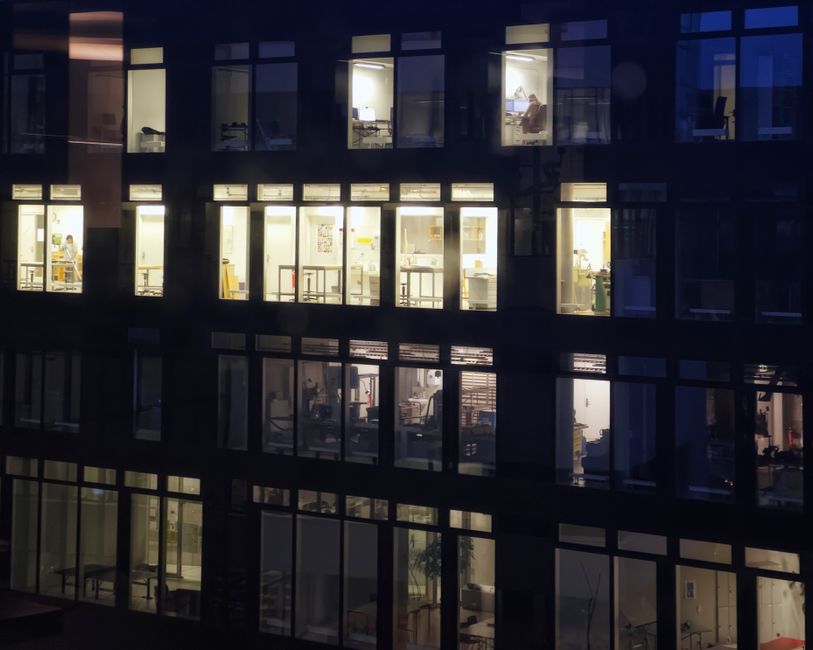
Lucile Marchand has signed twelve new tenant contracts since January. Her co-working and flexible office complex, Atelier Jemmapes, occupies 3,400 square metres of a rehabilitated 19th-century warehouse at 74 quai de Jemmapes, and every desk is taken. On a property market where central Paris office vacancy hit 8.3 percent at the close of Q1 2026 — the highest figure recorded since the post-COVID restructuring of 2022 — that is not a small thing.
The timing matters for reasons that go well beyond one entrepreneur's occupancy ledger. Paris is sitting on roughly 4.2 million square metres of vacant office space across the Île-de-France region, according to figures published by the Observatoire de l'Immobilier Commercial in May. Landlords who spent the 2010s pouring capital into gleaming La Défense towers and Haussmanian prestige addresses in the 8th arrondissement are now facing a hard reckoning: the five-year, full-floor corporate lease is no longer the default product. Marchand saw this coming in 2021 and moved before the market forced anyone's hand.
From Dying Showrooms to Thriving Micro-Offices
The 10th arrondissement was not an obvious bet. The stretch of the Canal Saint-Martin between the rue du Faubourg-du-Temple and the rue de la Grange-aux-Belles had spent the better part of two decades as an awkward in-between zone — too industrial for luxury tenants, too expensive for artists. Marchand, who previously ran operations at a mid-sized proptech firm based near the Opéra Garnier, negotiated a 15-year lease on the Jemmapes warehouse in late 2023 at €280 per square metre annually, well below the €550-plus benchmarks then being quoted for comparable space in the 2nd arrondissement's Sentier district.
Her model is straightforward but the execution is precise. Atelier Jemmapes offers private offices ranging from 18 to 120 square metres on rolling three-month contracts, supported by shared meeting rooms, a ground-floor café managed in partnership with the specialty roaster Terres de Café, and a dedicated events space on the top floor with a terrace overlooking the canal. Monthly desk memberships start at €350 for hot-desking and rise to €2,800 for a private six-person studio. Occupancy costs, she argues, run roughly 30 percent below what a comparable small team would pay for a serviced office in the Marais or near République.
The tenant mix tells its own story. Of the 87 companies currently based at Atelier Jemmapes, 34 are in technology or software, 19 work in design or architecture, and the remainder span legal, communications and import-export. Several relocated from the WeWork space that closed on rue du Quatre-Septembre in the 2nd in early 2025, following the global operator's continued portfolio contraction in France.
What the Numbers Suggest for Paris Property
The broader Paris office market is bifurcating sharply. Prime rents in La Défense's Grande Arche cluster remain sticky around €600 per square metre per year, propped up by large financial and energy firms renewing long-term leases. But second-tier space in the 9th, 10th and 11th arrondissements is a different story. Vacancy in the inner-ring districts east of the Boulevard de Sébastopol climbed to 11.7 percent in Q1 2026, according to the same Observatoire report, and landlords are increasingly open to shorter contract terms and fit-out contributions that would have been unthinkable four years ago.
For Marchand, that structural loosening is an opportunity, not a threat. She has signed a heads-of-agreement on a second site — a former printing plant near the Gare de l'Est, on the rue du 8 Mai 1945 — and expects to open it by the first quarter of 2027 with approximately 2,800 square metres of additional space. The Paris City Council's broader Canal de l'Ourcq regeneration program, which is directing €180 million in public investment into the northeastern arrondissements through 2028, adds a longer-term tailwind.
Small and mid-sized companies hunting for Paris office space this autumn should look closely at the 10th and 11th before committing to anything in the more established districts. Marchand's model will not suit every business — month-to-month flexibility has a price premium per square metre over a conventional three-year bail commercial — but for teams of between two and twenty people, the arithmetic is changing fast, and the landlords who once held all the cards know it.