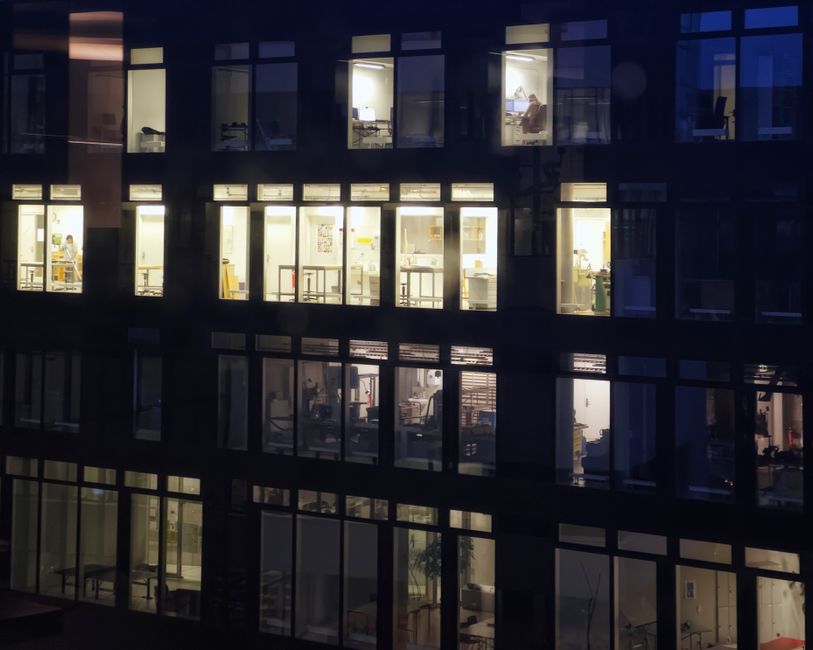
Camille Marchand signed the lease on a derelict printworks on Rue du Faubourg Saint-Martin in January 2024 for €185 per square metre per year — roughly 40 percent below the going rate for comparable footage in the 8th arrondissement. Eighteen months later, her company, Bureau Vivant, has 94 percent occupancy across three floors, a waiting list of 60 companies, and a second site opening on Rue de la Roquette in the 11th this September.
The timing matters. Paris is sitting on its highest office vacancy rate in fifteen years. According to data published by property consultancy CBRE France in the first quarter of 2026, roughly 4.2 million square metres of office space across Île-de-France stood empty — up from 3.6 million at the same point in 2024. The La Défense business district alone recorded a vacancy rate of 14.8 percent, its worst figure since the post-financial-crisis slump. Landlords who spent a decade courting CAC 40 anchors on long leases are now watching those same companies shed square footage as hybrid working becomes permanent policy rather than pandemic stopgap.
Filling the Gap the Grand Bureaux Left Behind
Bureau Vivant's model sits between the traditional serviced office — think Regus or WeWork, which collapsed its French operation in 2023 — and a full private lease. Tenants sign rolling six-month agreements for between 4 and 40 desks. They get dedicated, walled-off space rather than hot desks, access to shared meeting rooms branded under Bureau Vivant's own design aesthetic, and a utilities bundle. The Faubourg Saint-Martin site charges €650 per desk per month, inclusive. A comparable arrangement at a traditional serviced operator in the 9th arrondissement currently runs closer to €900.
The 10th arrondissement location is deliberate. The neighbourhood sits adjacent to Gare du Nord and Gare de l'Est, making it genuinely useful for clients with staff commuting from the northern suburbs or from London via Eurostar. Marchand spent two years working at SNCF Immobilier, the real estate arm of France's national rail operator, before striking out on her own, and that transit logic runs through every site decision she makes. The Roquette address, near Place de la Bastille, targets a different profile — creative and tech firms priced out of the Marais over the past decade.
Her tenants currently include 14 startups, 8 mid-sized legal and consulting firms, and a handful of foreign companies — among them a German logistics firm and a Canadian fintech — using Paris as their EU headquarters post-Brexit. That last category has grown sharply. France Invest, the trade body for private equity and venture, reported in May 2026 that Paris absorbed 34 new international financial and professional services registrations in the first four months of the year, the highest January-to-April figure since 2017.
What Comes Next for the Market
Bureau Vivant is not alone in chasing this space. La Permanence, which operates two sites near Opéra in the 9th, and Darwin Offices, with a location on Avenue de Wagram, are both expanding their Paris footprints in 2026. But the broader office market faces structural pressure that no amount of flex innovation fully resolves. JLL France forecasts that take-up of new office space across Paris and its inner suburbs will stay below 1.9 million square metres in 2026, compared with a pre-pandemic average of around 2.4 million. Several large developments along the Seine-Saint-Denis corridor, originally planned for 2025 delivery, have been pushed to 2028 or later as developers wait for conditions to improve.
For companies currently hunting space in the capital, the practical picture is mixed. Rents in prime addresses — Avenue George V, the Triangle d'Or, the western edge of the 1st — have held firm or nudged upward because supply there is genuinely constrained. But in secondary locations from the 13th eastward, tenants willing to negotiate and take on a shell-and-core fit-out can find rates not seen since 2010. Marchand's bet is that many of those companies will not bother. They want someone else to have already done the work. In Faubourg Saint-Martin, at least, that gamble is paying off.