Why Paris's Transport System Remains the Gold Standard Other Cities Can't Quite Match
From the seamless Metro to riverside cycling paths, Paris has cracked a code of urban mobility that leaves global competitors scrambling.
From the seamless Metro to riverside cycling paths, Paris has cracked a code of urban mobility that leaves global competitors scrambling.

Stand at Châtelet station during rush hour and you'll witness something remarkable: chaos that somehow works. Thousands of commuters flow between the Metro's five intersecting lines with an almost balletic efficiency that would baffle transit planners in New York, London, or Tokyo. This is the paradox at the heart of Paris's transport supremacy—a system so layered, so intricately woven into the city's fabric, that it has become nearly impossible for other metropolises to replicate.
The numbers tell part of the story. The RATP's Metro carries 1.6 billion passengers annually across 16 lines and 307 stations, with trains arriving every 90 seconds on peak routes. A monthly Navigo pass costs €84.40—significantly cheaper than London's Oyster system or New York's MTA fare. But the real advantage isn't mathematical; it's architectural. Unlike sprawling subway systems elsewhere, Paris compressed its network into a city where no resident lives more than 500 metres from a station. You can traverse from Belleville to Boulogne-Billancourt without ever stepping aboveground.
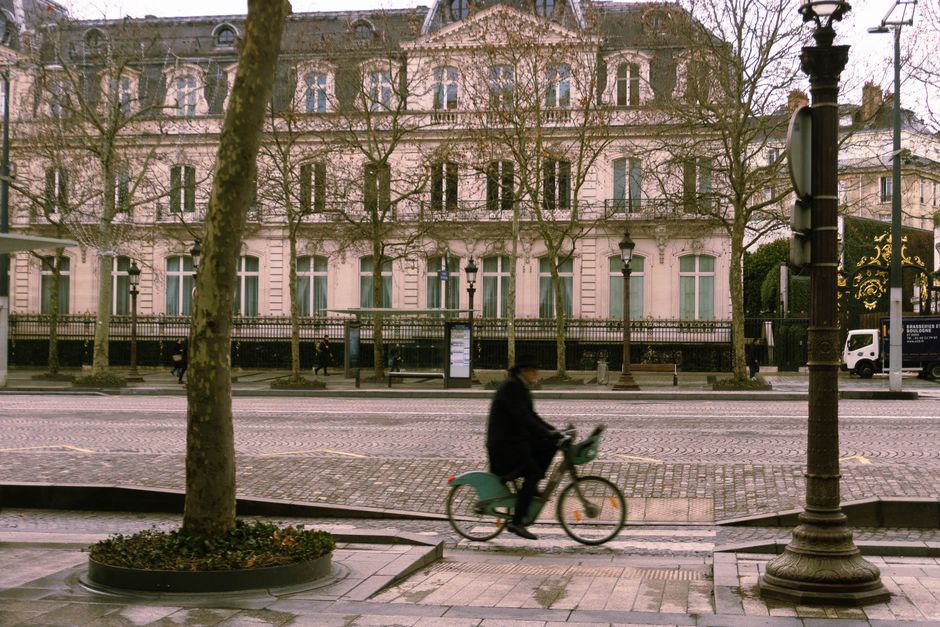
Yet Paris has refused to rest on this legacy. The city's 2015 commitment to cycling infrastructure has transformed commuting patterns entirely. Over 1,400 kilometres of cycling lanes now crisscross the capital—including the magnificent Promenade Plantée that curves through the 12th arrondissement, and the newer protected lanes along the Seine that connect Pont de l'Alma to Pont Marie. The Vélib' system, with 14,000 bikes across 1,400 stations, has become a transport mode rather than a novelty. Compare this to cities still debating whether cyclists deserve dedicated space.
The bus network, often overlooked, deserves mention. With 369 daytime lines and 56 night routes, Paris's RATP buses provide flexibility that rail alone cannot. A cross-town journey on line 38 from Gare de Lyon to Pont de Neuilly offers street-level Paris that no Metro tunnel can deliver.
What truly separates Paris is philosophical. While other cities treat transport as a problem to solve, Paris treats it as a civic inheritance. The integration is seamless—RER trains connect suburbs to centre in 45 minutes; electric buses are gradually replacing diesel; tram lines like T3b arc through forgotten neighbourhoods, gentrifying thoughtfully rather than violently.
Other cities have copied elements: Berlin's U-Bahn efficiency, Copenhagen's cycling culture, Tokyo's punctuality. But none have synthesized these into a coherent system that works at human scale. Paris's transport doesn't just move bodies—it shapes daily life, enabling the flânerie, the café culture, the spontaneous neighbourhoods that make this city irreplaceable. That's what can't be imported, and why Paris's competitors remain perpetually behind.
This article was compiled by AI from the sources linked above and screened before publishing. See our editorial standards.
How does this story make you feel?
Spread the word
About this article
Published by The Daily Paris
Daily brief
Free, in your inbox before 7am. Weekdays.
More in lifestyle